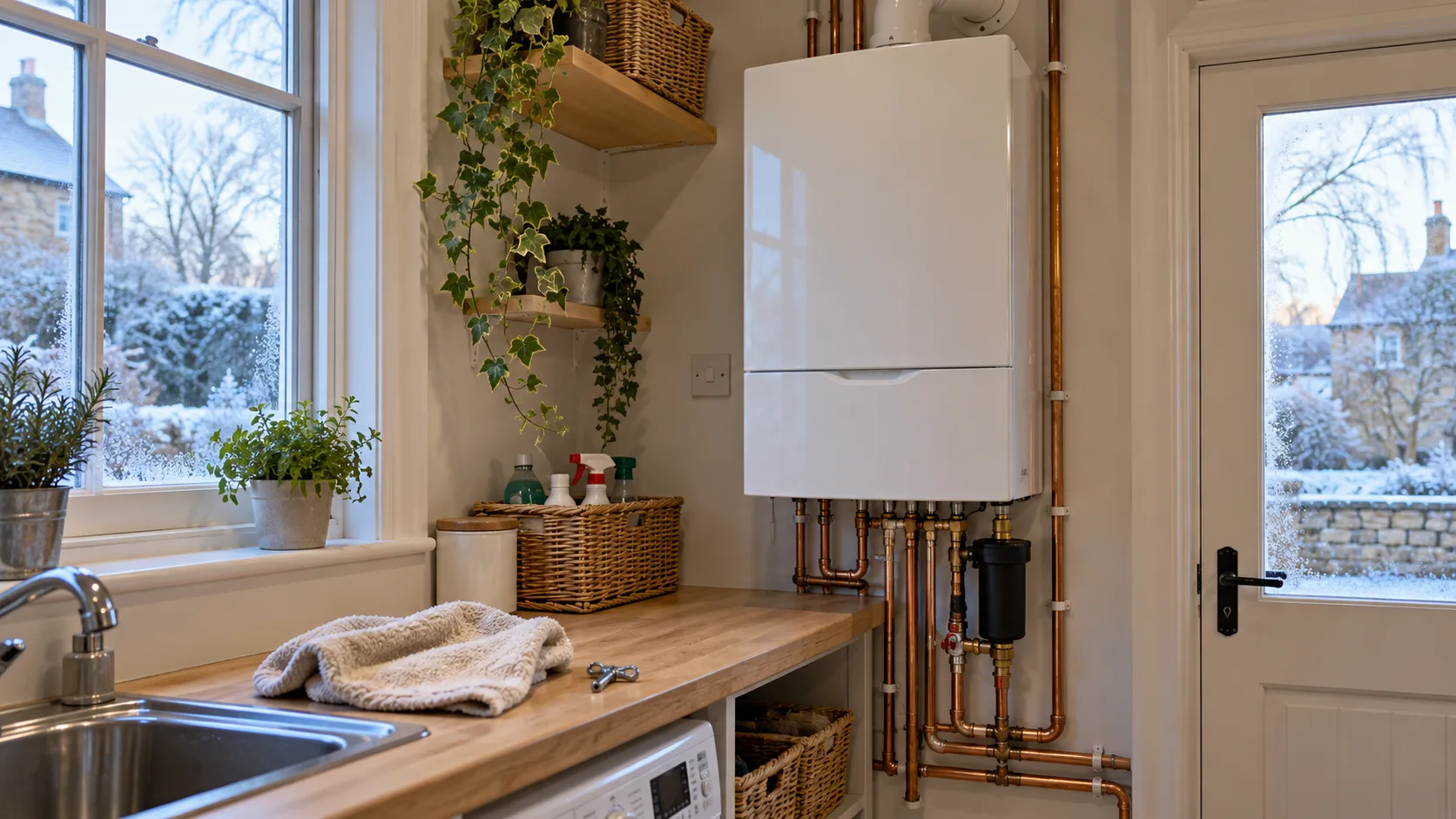
A boiler that’s suddenly noisier than usual is telling you something. Gurgling usually means air or a frozen condensate pipe, banging or rumbling often points to limescale or sludge, and whistling can mean restricted water flow. Some of this you can check yourself, but anything that keeps going needs a heating engineer to look at it. We see a lot of noisy boilers in Oxford and Abingdon once the heating starts working hard in November.
Gurgling
A gurgle is the most common winter noise.
- Air in the system. Often heard after the system has been drained or topped up. Radiators that are cold at the top confirm it.
- Low pressure. If the gauge reads below 1 bar, air can get drawn round the system.
- Frozen condensate pipe. In freezing weather the plastic pipe that runs outside from the boiler can ice up. The boiler gurgles, then usually stops with a fault code.
Bleeding the radiators and topping up the pressure often sorts the first two. For a frozen condensate pipe, warm (not boiling) water poured over the outside section usually thaws it.
Banging, rumbling or kettling
A noise like a kettle coming to the boil, or loud bangs from the boiler, is known as kettling. Water is overheating and boiling in the heat exchanger, usually because something is slowing its flow.
The common causes are limescale build-up, sludge from old radiators and pipes, or a pump that isn’t moving water round properly. Hard water areas see more of it, and much of Oxfordshire has hard water.
Kettling isn’t something to fix yourself. It puts strain on the heat exchanger, which is an expensive part to replace. An engineer may recommend descaling, a power flush or a new pump, depending on what they find.
Whistling
A high-pitched whistle often has the same root cause as kettling: restricted flow through the heat exchanger. It can also come from a partly closed valve, a pump running too fast or air trapped in the boiler. If it starts after work on the system, mention that to the engineer.
Humming and vibrating
A low hum can come from the pump, a fan or loose pipework that vibrates against a joist or wall. Sometimes it’s just a pipe clip that has worked loose. If the noise comes from inside the boiler casing, leave it to an engineer.
Banging pipes rather than the boiler
Not every noise comes from the boiler itself. Pipes expand and contract as they heat up and cool down, and can tick or knock where they pass through floors. A sharp bang when a tap shuts off is usually water hammer, which is a plumbing issue rather than a heating one.
Safe checks you can do
- Check the pressure gauge. Around 1 to 1.5 bar when cold is normal for most systems
- Bleed any radiators that are cold at the top, then re-check the pressure
- Check the condensate pipe outside for ice in freezing weather
- Note when the noise happens: heating, hot water, or both
Don’t remove the boiler casing or attempt any repairs inside it. All work on the boiler, its gas supply or flue must be done by a Gas Safe registered engineer. If a noise comes with a smell of gas, leave the property and call the National Gas Emergency Service on 0800 111 999.
Noisy boilers around Oxford, Didcot and Wallingford
Hard water across much of Oxfordshire means limescale is a regular cause of boiler noise here, especially on older systems that have never been flushed. Homes in Didcot and Wallingford with exposed condensate pipes on north-facing walls are more likely to see winter gurgling and freeze-ups. A scale reducer or better pipe insulation can make a real difference.
Frequently asked questions
Is a noisy boiler dangerous?
Usually it’s a sign of wear or a blockage rather than immediate danger. But kettling and loud banging put strain on parts and shouldn’t be ignored. If the noise comes with a smell of gas, scorch marks, a lazy yellow flame or a carbon monoxide alarm going off, turn the boiler off and get help straight away.
Why does my boiler only gurgle when it’s freezing outside?
That pattern almost always points to the condensate pipe. When the outside section freezes, waste water backs up into the boiler, which gurgles and then shuts down. Thawing the pipe gets it running again. Insulating or rerouting the pipe can stop it happening every cold snap.
Will a power flush stop my boiler making noises?
It can, if the noise is caused by sludge or debris restricting flow through the system. It won’t fix a failing pump or a heavily scaled heat exchanger on its own. An engineer should find the cause first, then recommend the right fix rather than a flush by default.
Get that noise checked
If your boiler has started banging, gurgling or whistling, give us a call on 01865 817 611 or drop us a message and we’ll find out what’s causing it before it turns into a breakdown.