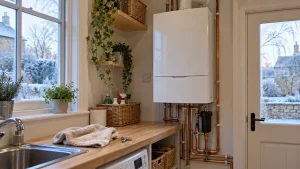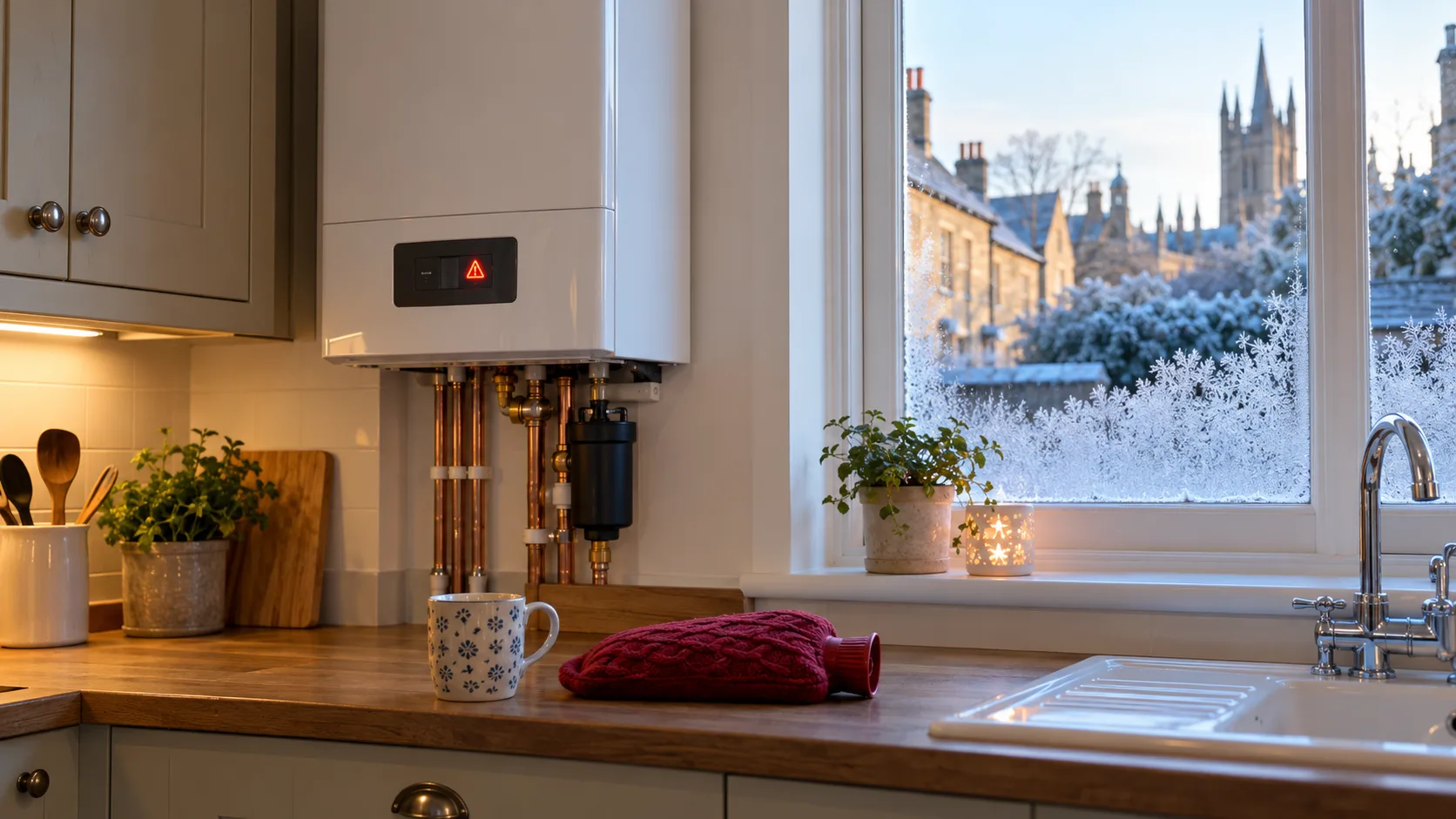
If your boiler stops on a cold day, run through a few safe checks first: power, thermostat, timer, pressure and any fault code. A surprising number of winter “breakdowns” are a tripped switch, a reset clock or low pressure. If those don’t bring it back, stop there, keep the house warm another way and book a heating engineer. We cover Oxford, Wallingford and the villages in between, and cold snaps are when the calls come in fastest.
Safe checks before you call anyone
These are all things a homeowner can look at without opening the boiler.
- Power. Is the display lit? Check the fused spur switch next to the boiler and your fuse box.
- Thermostat and timer. Turn the room thermostat up a few degrees. After a power cut, programmers often lose the time or revert to default settings.
- Pressure. Most systems should read about 1 to 1.5 bar when cold. If it’s below 1, the boiler may have shut down to protect itself.
- Fault code. Write it down. It helps the engineer arrive with the right parts.
- Reset once. If the manual shows a reset button, press it once. If the boiler locks out again, leave it.
In freezing weather, a condensing boiler can also stop because its condensate pipe outside has frozen. You’ll often hear gurgling first. Pouring warm, not boiling, water over the outside section of pipe can thaw it, but only do this if the pipe is at ground level and easy to reach safely.
What not to do
Don’t take the casing off, poke around inside or keep resetting a boiler that keeps locking out. Repeated resets can make some faults worse. Any work on gas parts, the flue or the boiler internals must be done by a Gas Safe registered engineer.
If you smell gas at any point, open the windows, don’t use light switches or anything that might spark, turn off the gas at the meter if it’s safe to do so, leave the property and call the National Gas Emergency Service on 0800 111 999.
Keeping warm while you wait
Heat one room well
Pick the room you use most, close the door and heat that. An oil-filled radiator or fan heater will warm a single room far better than trying to heat the whole house. Keep heaters clear of curtains and bedding, and never leave them running unattended or overnight in a child’s room.
Keep the heat in
Close curtains as soon as it gets dark, block draughts under doors and shut off rooms you’re not using. Layers and hot water bottles help more than people expect.
Protect the pipes
If the house is going to get very cold, pipes in lofts, garages and on outside walls are at risk. Open the loft hatch to let some warmth up, and leave kitchen cupboard doors open where pipes run along outside walls. Know where your stopcock is in case anything does freeze and split.
Hot water
If you have an immersion heater in a cylinder, you can usually still get hot water even with the boiler down. Combi boiler owners will need the kettle for washing up until the repair is done.
Breakdowns in older Oxfordshire homes
Homes in Oxford, Didcot and Abingdon range from Victorian terraces with solid walls to modern estates. Older, draughtier homes lose heat quickly once the boiler stops, so they get cold within hours on a frosty night. Older systems also tend to carry more sludge and worn parts, so they often fail in the first cold weeks.
Repair or replace?
Most breakdowns are fixable. But if your boiler is well over ten years old, has broken down more than once this winter or needs a major part, it’s worth asking whether the money is better spent on a replacement. Our post on whether it’s worth repairing an old boiler explains what to weigh up.
Frequently asked questions
Why do boilers break down more in winter?
Mostly because they’re working harder. A boiler that’s coped quietly with hot water all summer suddenly runs for hours a day in the cold. Weak parts fail, sludge builds up in the radiators and condensate pipes can freeze. A service before winter catches many of these problems before they leave you without heat.
Is it safe to keep resetting my boiler?
Resetting once is fine if your manual allows it. If the boiler locks out again, there’s a reason, and repeated resets won’t fix it. Some faults, such as flame or overheat problems, can get worse. Write down the fault code, leave the boiler off and book a Gas Safe registered engineer to find the cause.
How can I tell if my condensate pipe has frozen?
The usual signs are a gurgling noise from the boiler, a fault code on the display and the boiler stopping during freezing weather. Look at the plastic pipe running outside from the boiler to a drain. If it’s frozen solid or has ice at the end, that’s likely the cause. Warm water over the outside section usually thaws it.
Get your boiler back up and running
If your boiler has let you down in the cold, give us a call on 01865 817 611 or drop us a message and we’ll come out, find the fault and get your heating back on.